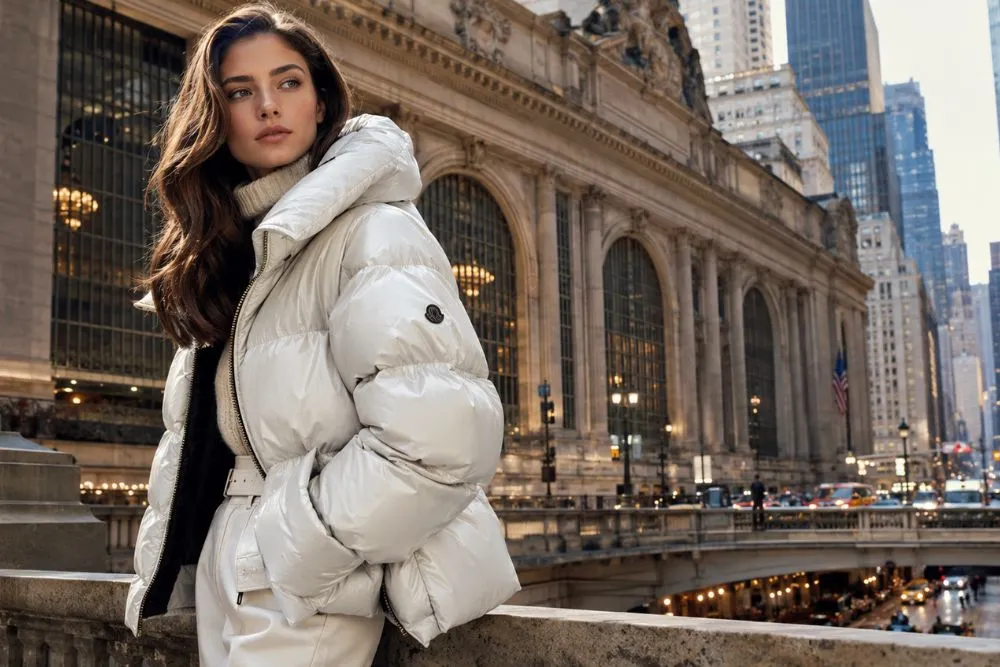
The Moncler exhibition at New York Fashion Week, officially titled New York in Moncler, transformed the city into a retrospective of more than two decades of Moncler fashion, performance, photography, and cultural moments. Running September 9–13, 2026, the exhibition spread across New York before culminating in a dedicated presentation at Vanderbilt Hall in Grand Central Terminal.
New York in Moncler was a citywide retrospective celebrating Moncler’s long relationship with New York, with large-scale imagery and landmark moments spanning 2010–2026. Its Grand Central presentation highlighted the brand’s history of turning technical outerwear into a broader language of fashion, performance, art, and metropolitan style.
What Was the Moncler Exhibition at New York Fashion Week?
New York in Moncler was not a conventional runway show presenting a single new seasonal collection. Instead, Moncler used New York itself as the exhibition space, revisiting major fashion shows, campaigns, collaborations, performances, and cultural encounters that shaped the relationship between the brand and the city.
The format matters because Moncler has long operated between categories. Its technical outerwear originated in an alpine context, but its New York history shows how performance clothing can become part of an urban visual vocabulary without completely abandoning its functional identity.
Rather than treating the puffer as merely winter equipment, the retrospective presents it as a cultural object capable of appearing in public performances, editorial imagery, celebrity wardrobes, and large-scale fashion spectacles. That distinction is central to understanding why the exhibition belonged naturally within Fashion Week.
When and Where Was New York in Moncler?
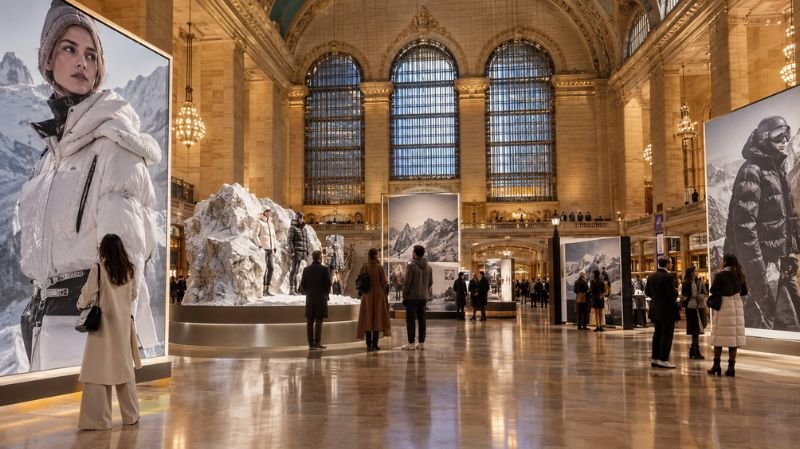
The exhibition ran from September 9 through September 13, 2026, coinciding with New York Fashion Week. Large-scale photographs appeared across New York, while the central exhibition space was located in Vanderbilt Hall at Grand Central Terminal.
The City Edit listed Vanderbilt Hall at 89 East 42nd Street as the principal public location and reported daily hours of 9 a.m. to 9 p.m. during the exhibition period. Because the event has now concluded, those dates should be treated as historical rather than current visitor information.
The choice of Grand Central was particularly fitting. The terminal has already appeared in Moncler’s New York fashion history, meaning the exhibition returned to a location that was itself part of the story being remembered.
Why Was Grand Central Terminal Important to the Exhibition?
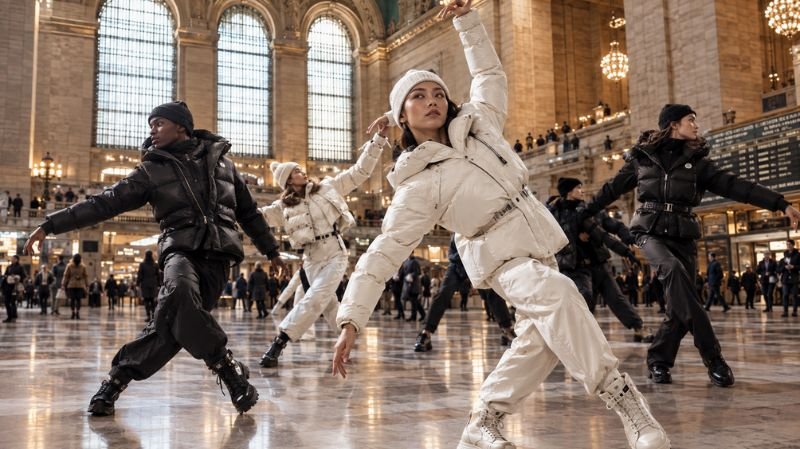
Grand Central was more than a convenient exhibition venue. In 2011, Moncler Grenoble turned the terminal’s Main Concourse into an unexpected stage for a Fall/Winter New York Fashion Week presentation featuring 140 dancers in technical alpine clothing.
That earlier spectacle helps explain the logic behind the 2026 retrospective. Moncler was not simply bringing mountain clothing into Manhattan; it was repeatedly using highly recognizable New York environments to demonstrate how its alpine identity could interact with urban life.
The result is a recurring fashion idea: the city becomes the runway, while the clothing becomes the connection between performance and everyday life. That is arguably more important to Moncler’s New York identity than any individual puffer or celebrity appearance.
The Moncler New York Moments That Shaped the Exhibition
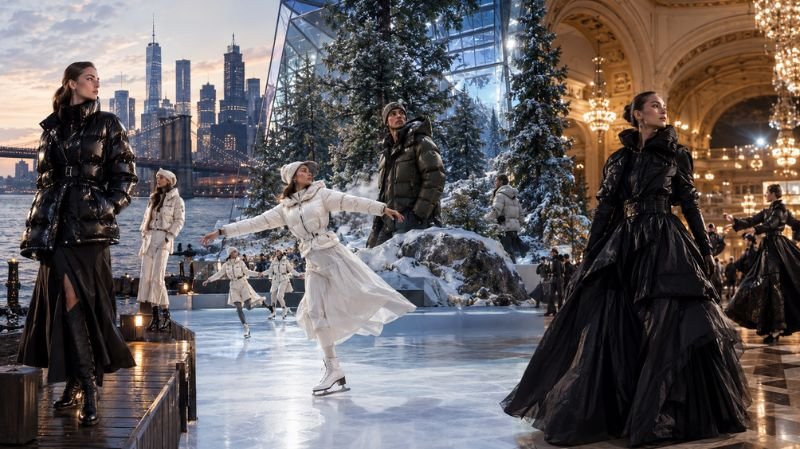
The strongest part of New York in Moncler was its historical range. Instead of presenting an isolated 2026 activation, the exhibition connected multiple moments across more than a decade of Moncler’s New York activity.
A Hudson Hike — Chelsea Piers, 2010
Moncler’s New York story began, in the retrospective timeline, with A Hudson Hike at Chelsea Piers in 2010. Around 100 Moncler Grenoble-clad models climbed scaffolding transformed into an urban interpretation of a mountain environment.
From a fashion perspective, the staging established an important Moncler formula: take an element associated with extreme outdoor environments and place it inside an unmistakably metropolitan setting. The contrast creates the spectacle while keeping the technical character of the clothing visible.
A Grand Groove — Grand Central Terminal, 2011
In 2011, A Grand Groove transformed Grand Central’s Main Concourse into a surprise runway. Moncler Grenoble dressed 140 dancers in technical alpine clothing, creating movement and performance around commuters rather than a conventional seated fashion audience.
This moment is especially useful for understanding Moncler’s approach to fashion presentation. The clothes were not presented as static objects; movement became part of the design story, emphasizing the relationship between technical apparel, physical activity, and performance.
A Central Skate — Central Park, 2012
The following year, Moncler brought its alpine vocabulary to Wollman Rink in Central Park. Professional skaters performed in red, white, and blue while a live orchestra of New York musicians accompanied the presentation.
The location reinforced the brand’s ability to make winter clothing feel culturally native to New York. Instead of hiding technical garments behind showroom walls, Moncler placed them in an environment where movement, weather, sport, and spectacle naturally belonged together.
A Gotham Forest — Gotham Hall, 2013
For A Gotham Forest in 2013, Moncler Grenoble transformed Gotham Hall into an alpine-inspired environment. The installation featured a tiered “Inner Forest” formation involving nearly 370 green-clad models, according to Moncler’s retrospective material.
The scale of the presentation illustrates another recurring Moncler strategy: exaggerating the contrast between nature and architecture. In Manhattan, an artificial forest becomes a fashion set, allowing the brand’s mountain heritage to remain visible without reproducing an actual alpine landscape.
A Ballroom Ballad — Hammerstein Ballroom, 2014
In 2014, Hammerstein Ballroom became the setting for another Moncler Grenoble spectacle. Sixty choristers formed a living backdrop for the Pendulum Choir installation by Swiss artists André and Michel Décosterd, performed on hydraulic platforms.
This was fashion presented through sound, movement, engineering, and architecture. The clothes remained important, but the experience demonstrated how Moncler increasingly positioned itself at the intersection of fashion, performance, design, and contemporary culture.
From Fashion Shows to Art, Photography and Pop Culture
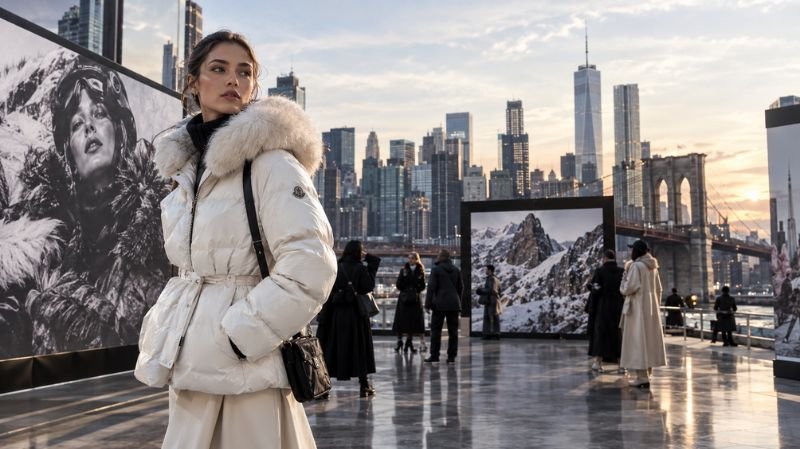
Moncler’s New York story did not stop at runway presentations. The retrospective also connected the brand with photography, public art, entertainment, music, and recognizable New York personalities.
One notable example is Annie Leibovitz’s 2014 Moncler campaign, photographed on top of the Chrysler Building. The image-making extended Moncler’s alpine visual language into one of Manhattan’s most recognizable architectural landmarks.
The exhibition also revisited Art for Love, a 2015 project at the New York Public Library, alongside later cultural moments involving figures including Spike Lee, Alicia Keys, Sarah Jessica Parker, Penn Badgley, Vittoria Ceretti, Robert De Niro, and Al Pacino.
That evolution is significant because it shows Moncler moving from the traditional definition of a fashion brand toward a broader cultural identity. Its New York presence is increasingly communicated through people, places, architecture, music, art, and storytelling as much as through clothing.
Sarah Jessica Parker and the Moncler Puffer Gown
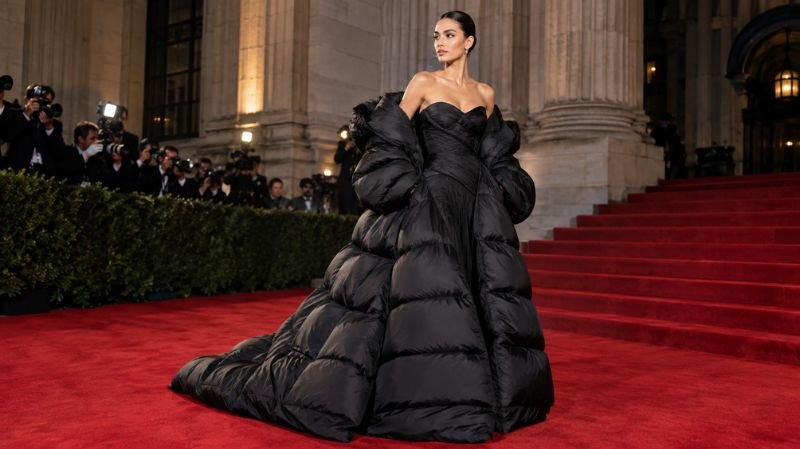
One of the exhibition’s more recognizable fashion references is Sarah Jessica Parker’s Moncler puffer gown, originally co-created with Pierpaolo Piccioli for Moncler Genius in 2019 and later associated with Parker’s And Just Like That… appearance.
The design is useful because it challenges the conventional assumption that a puffer belongs only to casual or utilitarian dressing. By translating down-filled outerwear into a dramatic gown silhouette, the design pushed Moncler’s technical vocabulary toward couture-like proportions and red-carpet styling.
For fashion followers, that is one of the clearest examples of Moncler’s larger creative proposition: technical construction does not have to dictate a technical-looking silhouette. Volume, quilting, insulation, and protection can become visual drama.
Vittoria Ceretti and Moncler at the Met Gala
The retrospective also highlighted Vittoria Ceretti’s 2025 Met Gala appearance in Moncler, which marked the brand’s presence at fashion’s most closely watched annual red-carpet event. ELLE identified the look as part of the exhibition’s “The Red Carpet” material.
Its inclusion broadens the New York story beyond traditional Fashion Week. The Met Gala represents a different form of fashion influence, where clothing operates through celebrity, interpretation, theme, photography, and cultural conversation rather than a runway collection alone.
That distinction is worth noting when assessing Moncler today. Its visibility in New York comes from multiple fashion ecosystems at once: runway presentation, street style, performance, editorial photography, entertainment, and red-carpet dressing.
Alicia Keys and the New York State of Mind
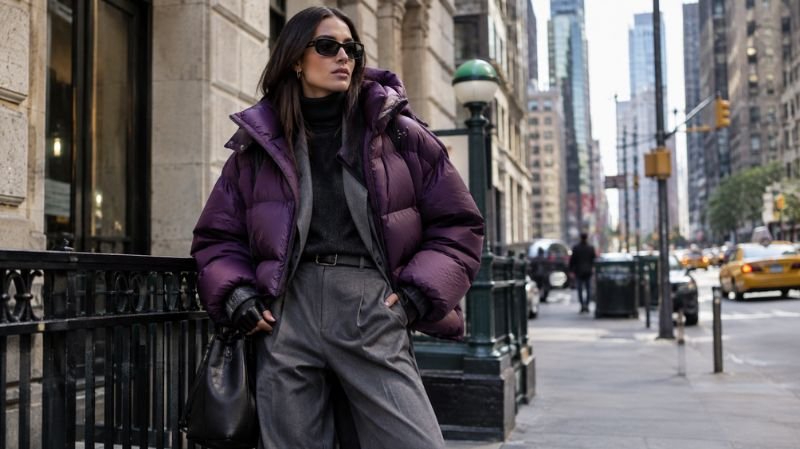
Alicia Keys occupies a particularly meaningful position in the 2026 project. She narrated Moncler’s accompanying film about the relationship between the brand and New York, released September 3, with the film using her voice and unreleased music.
Keys was also featured in A State of Mind, a 2023 Moncler collaboration inspired by her memories of 1990s New York. Moncler describes the collection through oversized silhouettes, technical textures, and bold color, including her signature purple.
This is more than celebrity association. Keys provides a distinctly New York cultural lens, helping shift the narrative from “luxury brand visiting New York” toward “luxury brand interpreting a city through someone who is deeply associated with it.”
What Does the Exhibition Say About Moncler’s Fashion Identity?
The most useful takeaway from New York in Moncler is that Moncler has built its contemporary identity around contrast. The brand’s visual language repeatedly places alpine functionality against metropolitan environments.
That contrast explains why a down jacket can move from a mountain setting to Grand Central, Central Park, a red carpet, or a celebrity campaign without feeling completely disconnected from its original purpose. The environment changes, but the ideas of warmth, protection, mobility, and volume remain.
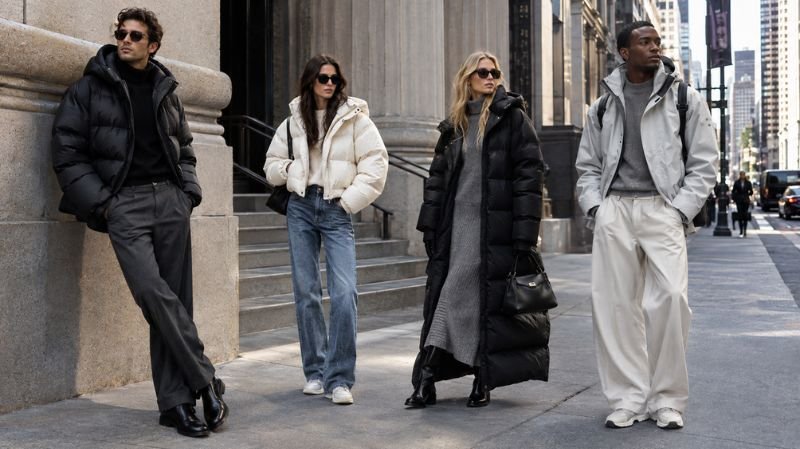
From a styling perspective, this creates a useful lesson: technical clothing becomes more versatile when the rest of the outfit provides contrast rather than matching it head-to-toe. A substantial puffer can work with tailored trousers, a slim knit, a long skirt, or polished footwear precisely because the surrounding pieces change its visual message.
How to Style the Moncler Look Beyond Winter Sportswear
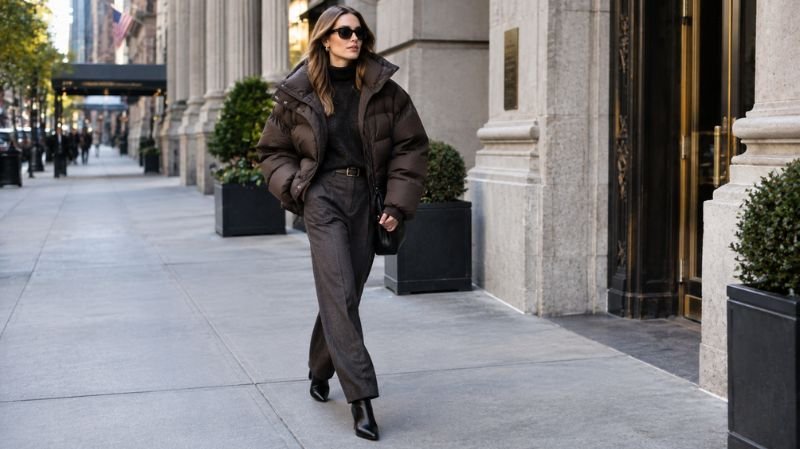
The most wearable interpretation of Moncler’s New York aesthetic is not a head-to-toe technical outfit. Instead, combine one recognizable piece of performance outerwear with cleaner metropolitan staples.
| Moncler-inspired piece | Pair it with | Fashion effect |
| Oversized puffer | Tailored trousers + sleek boots | Technical-meets-tailored |
| Short down jacket | Straight-leg denim + loafers | Urban and relaxed |
| Long puffer | Knit dress + ankle boots | Refined winter layering |
| Technical shell | Wide-leg trousers + minimal sneakers | Modern utility |
| Statement-colored outerwear | Neutral knitwear + trousers | Controlled color contrast |
| Belted outerwear | Simple column skirt + boots | Defined silhouette |
| Moncler Grenoble-inspired layers | Everyday denim + understated accessories | Outdoor influence without ski styling |
The key is proportion. If the jacket is oversized, keeping at least one other element of the outfit relatively clean can prevent the look from becoming visually heavy.
Color also matters. Moncler’s New York imagery often benefits from the tension between recognizable technical materials and the city’s neutral architectural palette, so black, charcoal, cream, navy, denim, and gray provide an easy foundation for stronger outerwear.
Moncler Exhibition vs. a Traditional New York Fashion Week Show
The difference between the retrospective and a conventional runway presentation is important for understanding its search intent.
| Feature | New York in Moncler | Traditional NYFW runway |
| Primary purpose | Retrospective and cultural storytelling | Present a collection |
| Format | Citywide imagery + exhibition | Scheduled runway presentation |
| Time frame | More than two decades of moments | Usually one season |
| Locations | Public spaces + Vanderbilt Hall | Dedicated fashion venue |
| Audience | Public-facing and cultural | Fashion industry + invited guests |
| Main story | Moncler + New York | Designer + collection |
| Fashion role | Historical and cultural | Seasonal and commercial |
Calling New York in Moncler simply a “Moncler runway show” therefore misses the point. Its strength was precisely that it connected many different forms of fashion communication across time.
Moncler Fifth Avenue: The Next Chapter of the New York Story
The exhibition coincided with the opening of Moncler Fifth Avenue, the brand’s largest global flagship, at 767 Fifth Avenue inside the General Motors Building. Moncler describes the store as an immersive expression of its “mountain-meets-metropolis” universe.
The two-level flagship measures approximately 23,680 square feet, according to current Moncler and event coverage. Its ground floor includes Moncler Collection, Moncler Genius and footwear, while the second floor is dedicated to Moncler Grenoble.
The interior was designed by Gilles & Boissier, with materials and architectural details intended to connect alpine references with New York’s visual language. Moncler also describes the entrance as drawing inspiration from Times Square and the space as a gallery-like environment.
This makes the flagship more than a retail footnote to the exhibition. The retrospective looked backward at Moncler’s New York history, while Fifth Avenue gives the brand a permanent physical setting from which to continue that relationship.
What Makes Moncler’s New York Strategy Different?
Many luxury brands use New York Fashion Week to generate attention around a collection. Moncler’s approach has been more environmental: make the city part of the fashion presentation itself.
Grand Central supplied movement and commuters. Central Park supplied winter sport. Gotham Hall supplied theatrical architecture. The Chrysler Building supplied verticality and iconography. These locations effectively became extensions of the Moncler visual identity.
That approach also explains why the 2026 exhibition feels coherent despite covering different years and formats. The consistent element is not one particular garment; it is the repeated collision between alpine functionality and metropolitan culture.
Key Moncler New York Fashion Moments at a Glance
| Year | Moment | Location | Why it matters |
| 2010 | A Hudson Hike | Chelsea Piers | Alpine spectacle brought into an urban waterfront setting |
| 2011 | A Grand Groove | Grand Central Terminal | 140 dancers turned a commuter hub into a fashion stage |
| 2012 | A Central Skate | Wollman Rink | Winter sport became part of the presentation |
| 2013 | A Gotham Forest | Gotham Hall | Alpine nature recreated inside Manhattan |
| 2014 | A Ballroom Ballad | Hammerstein Ballroom | Fashion merged with music, art and engineered performance |
| 2014 | Midtown Mountains | Chrysler Building | Annie Leibovitz photographed a Moncler campaign above NYC |
| 2015 | Art for Love | New York Public Library | Fashion connected with photography and cultural philanthropy |
| 2023 | A State of Mind | New York | Alicia Keys collaboration drew on her NYC memories |
| 2025 | Warmer Together | New York rooftops | Robert De Niro and Al Pacino represented friendship and connection |
| 2026 | New York in Moncler | NYC + Vanderbilt Hall | Retrospective brought the entire relationship together |
The chronology is based primarily on Moncler’s retrospective material and AFP’s publication of the exhibition details, rather than secondary fashion commentary.
What Should Fashion Readers Take Away From the Exhibition?
The exhibition’s biggest fashion lesson is that heritage becomes more powerful when it is translated rather than simply preserved. Moncler did not abandon its mountain identity when it entered New York; it repeatedly interpreted that identity through the city’s architecture, people, movement, and culture.
For personal style, that means technical fashion does not have to look overtly sporty. A puffer can become polished through tailoring, a shell can become urban through proportion, and winter accessories can feel sophisticated when paired with restrained silhouettes.
The more interesting Moncler look is therefore not necessarily the most obvious “Moncler” outfit. It is the one that takes the brand’s core ideas—volume, warmth, protection, technical construction—and places them into a distinctly personal wardrobe.
The Final Takeaway
The Moncler exhibition at New York Fashion Week was ultimately less about displaying clothes than explaining how a fashion identity can evolve through place. New York in Moncler connected more than two decades of performances, campaigns, collaborations, and cultural moments into one story about the meeting of alpine heritage and metropolitan life.
Its most compelling idea is also its simplest: Moncler did not have to choose between the mountain and the city. Grand Central, Central Park, Gotham Hall, the Chrysler Building, and Fifth Avenue became different stages for translating the same technical heritage into different forms of contemporary fashion.
For readers interested in the future of luxury outerwear, that may be the more important story than any single NYFW appearance. The modern puffer is no longer confined to ski slopes or freezing commutes; in the right styling context, it can function as tailoring, statement fashion, performance wear, or even cultural iconography.
Want to explore more fashion stories shaped by major designers, luxury houses, and New York style? Follow the latest fashion coverage and discover how heritage brands continue to redefine modern dressing.
Frequently Asked Questions
What is the Moncler exhibition in New York?
The exhibition was titled New York in Moncler, a citywide retrospective celebrating more than two decades of Moncler’s relationship with New York through photography, fashion presentations, cultural collaborations, and public performances.
When was the Moncler exhibition in New York?
New York in Moncler ran from September 9 through September 13, 2026, during New York Fashion Week. The exhibition has now concluded.
Where was the Moncler exhibition held?
The retrospective spread across New York City, with its principal dedicated exhibition space at Vanderbilt Hall inside Grand Central Terminal.
Was the Moncler exhibition part of New York Fashion Week?
Yes. The exhibition was scheduled during New York Fashion Week and revisited several earlier Moncler Grenoble presentations that had themselves taken place during NYFW.
What could visitors see in New York in Moncler?
The exhibition featured large-scale photographs and imagery documenting Moncler’s New York moments, including presentations at Grand Central Terminal, Central Park, Gotham Hall, Hammerstein Ballroom, and other cultural settings.
Why is Grand Central important to Moncler?
Grand Central hosted Moncler Grenoble’s 2011 Fall/Winter New York Fashion Week presentation, when 140 dancers in technical alpine clothing performed in the Main Concourse. The 2026 retrospective returned to Vanderbilt Hall within the same landmark terminal.
Who narrated the Moncler New York exhibition film?
Alicia Keys narrated the accompanying film released September 3, 2026. Moncler described the film as a visual story of the brand’s relationship with New York, accompanied by unreleased music from Keys.
What is the Moncler Fifth Avenue flagship?
Moncler Fifth Avenue is the brand’s largest global flagship, located at 767 Fifth Avenue in the General Motors Building. The two-level store brings together Moncler Collection, Moncler Genius, footwear, and Moncler Grenoble.
How does Moncler combine alpine and New York fashion?
Moncler repeatedly places technical alpine clothing into urban environments, using architecture, public spaces, performance, photography, and city personalities to reinterpret mountain-inspired design as metropolitan fashion.
What is the main fashion lesson from New York in Moncler?
The retrospective demonstrates how technical outerwear can move beyond purely functional dressing. Combining substantial outerwear with tailored, minimal, or refined pieces creates the contrast that makes the Moncler aesthetic feel urban rather than purely outdoors-oriented.