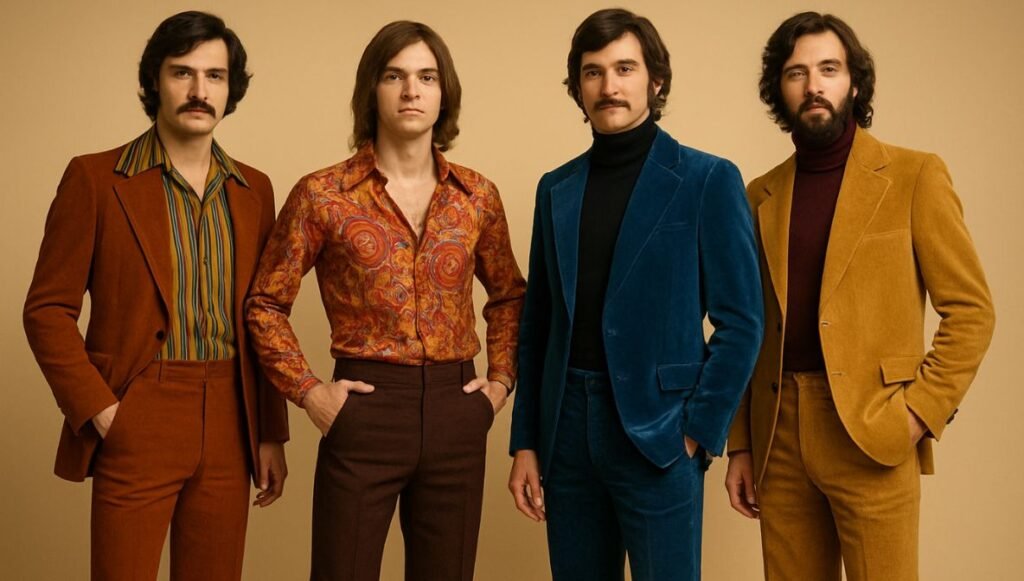

Men’s business professional attire is a polished, relatively formal dress code built around a well-fitted suit, dress shirt, conservative tie, and traditional dress shoes. For most workplaces, the safest modern formula is a navy or charcoal suit, crisp white or light-blue shirt, understated tie, polished leather shoes, and restrained accessories, then adjusted to the company’s culture and occasion.
The key is not simply wearing expensive clothing. Professional attire for men works when every element fits properly, coordinates naturally, and communicates that you understand the setting. In 2026, that means respecting traditional business standards without making your wardrobe look unnecessarily dated.
Quick Answer — What Is a Men’s Business Professional Attire?
The classic business professional outfit for men consists of:
- A two-piece suit in navy, charcoal, or another conservative color
- A crisp dress shirt, usually white or light blue
- A conservative tie
- Leather Oxford, Derby, or similarly formal dress shoes
- A leather belt coordinated with the shoes
- Dark, dress-appropriate socks
- Minimal accessories such as a watch, pocket square, or cufflinks
- Clean grooming and a properly tailored fit
When in doubt, dress slightly more formally rather than less formally—particularly for interviews, client meetings, presentations, and traditional industries.
What Does Business Professional Attire Mean for Men?
Business professional is one of the more formal workplace dress codes. It traditionally calls for a complete suit rather than the mix-and-match combinations associated with business casual. A professional outfit should look intentional, conservative, polished, and appropriate for the responsibilities of the wearer.
According to Indeed’s June 2026 workplace guidance, business professional remains common in more traditional industries such as banking, accounting, law, government, and finance, although workplace expectations vary by organization.
For a male business professional, the easiest way to think about the dress code is this:
Suit first, coordination second, personality third.
That order matters. You can express personal style through your tie, shirt texture, watch, pocket square, or subtle pattern, but the foundation should remain recognizably professional.
When Should Men Wear Business Professional Attire?

Business professional clothing is particularly appropriate when the occasion calls for authority, credibility, or traditional workplace formality.
Common situations include:
- Job interviews in conservative industries
- Client presentations
- Important business meetings
- Corporate conferences
- Formal networking events
- Court or legal settings
- Financial-services environments
- Government-related meetings
- Executive presentations
- Formal office environments
- Professional ceremonies and corporate events
The important caveat is that business attire for men is not governed by one universal rulebook. A technology company, investment bank, law firm, hospital, and advertising agency can have dramatically different expectations.
If the employer has provided a dress-code policy, follow it. If the instructions are vague, research the organization’s culture or ask the hiring manager, recruiter, or event organizer.
Why Has Men’s Business Professional Attire Changed Over Time?
The modern business suit is the result of a long shift toward simpler, more practical menswear.
The Metropolitan Museum of Art documents how the morning suit moved into daytime business use during the late 19th century, while the Smithsonian notes that the more relaxed sack or lounge suit eventually became the dominant business suit throughout the 20th century and into the 21st.
That history explains something important about today’s wardrobe: the business suit has always evolved.
How Did the Modern Business Suit Develop?
During the 18th and early 19th centuries, men’s clothing could be highly elaborate, with waistcoats, contrasting garments, decorative details, and strongly shaped silhouettes.
By the 19th century, menswear increasingly favored restraint and practicality. Matching jackets and trousers became increasingly important, and the lounge or sack suit offered a more practical alternative to earlier formal coats.
Ready-to-wear manufacturing also helped make suits more accessible. The Smithsonian describes the sack suit as a wool business suit with a looser single- or double-breasted jacket that dominated men’s fashion through much of the 20th century.
The lesson for modern dressing is useful: professional style has never been completely static.
Today’s well-dressed man can therefore respect the structure of traditional business attire while choosing contemporary proportions, comfortable fabrics, and cleaner silhouettes.
What Are the Essential Pieces of Men’s Business Professional Attire?
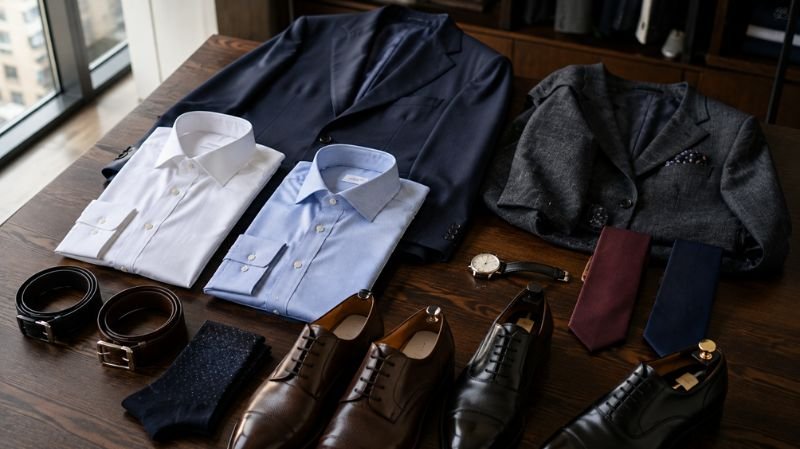
A successful professional wardrobe does not need dozens of garments. It needs a small number of reliable pieces that work together.
What Suit Should Men Wear for Business Professional Dress?
Start with a two-piece suit in a conservative color.
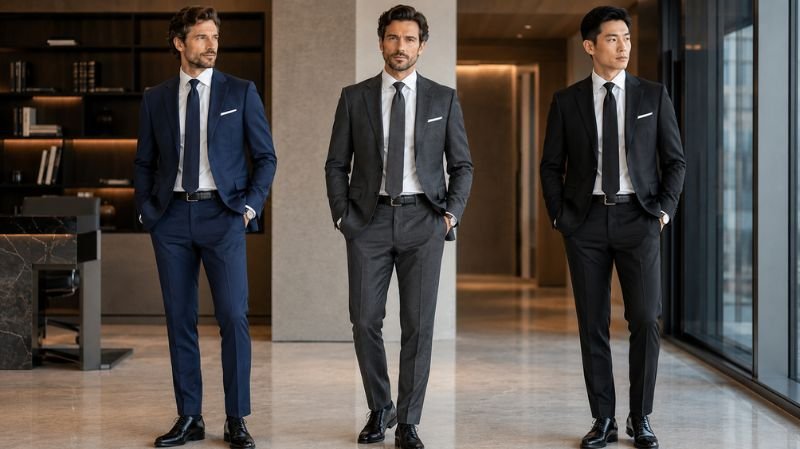
The strongest first choices are:
- Navy
- Charcoal gray
- Dark gray
- Black, when the workplace or occasion specifically supports it
Navy is arguably the most versatile starting point because it works with white and blue shirts and accommodates black, brown, and burgundy accessories.
Charcoal is slightly more conservative and particularly strong for interviews, financial settings, legal environments, and formal meetings.
A subtle pattern such as a restrained stripe or small check can work once the core wardrobe is established. Large windowpanes, bright checks, shiny fabrics, and highly contrasting patterns are better treated as fashion statements rather than default business professional pieces.
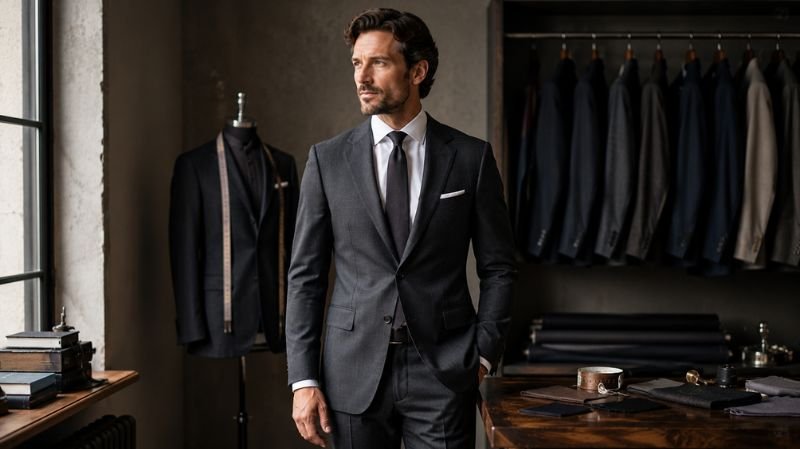
How Should a Business Professional Suit Fit?
Fit is more important than the label inside the jacket.
A professional suit should:
- Sit smoothly across the shoulders
- Close comfortably without pulling
- Keep the collar close to the shirt collar
- Have sleeves that reveal a small amount of shirt cuff
- Allow natural movement
- Fall cleanly through the torso
- Have trousers that sit securely at the waist
- Avoid excessive fabric pooling around the shoes
Do not confuse slim with professional.
An extremely narrow jacket or trouser can look just as inappropriate as an oversized suit. The goal is a clean silhouette that follows the body without restricting it.
A good tailor can make a significant difference. Sleeve length, trouser length, waist suppression, and jacket balance can transform an ordinary off-the-rack suit into convincing professional attire.
Which Dress Shirt Is Best for Business Professional Attire?
White is the safest starting point.
Light blue is the next essential option because it introduces color without compromising formality. Once those are covered, subtle stripes, very restrained checks, or pale neutral shades can add variety.
For a traditional business environment, prioritize:
- White
- Light blue
- Pale gray
- Very subtle stripes
- Crisp, opaque fabrics
- Properly fitted collars
Avoid shirts that are visibly wrinkled, excessively transparent, overly glossy, or designed around dramatic fashion details.
Do Men Need a Tie for Business Professional Dress?
In a traditional interpretation, yes—the tie is one of the clearest differences between business professional and business casual.
Choose ties in colors such as:
- Navy
- Burgundy
- Dark green
- Charcoal
- Muted blue
Classic stripes, small geometric patterns, and subtle textures are usually easier to integrate than novelty prints.
The tie should also reach approximately the waistband of your trousers or belt area. A tie that ends several inches above or below that point can make an otherwise excellent outfit look careless.
Which Shoes Work Best With Business Professional Attire?
Classic leather dress shoes remain the safest choice.
Oxford shoes are the most formal and conservative option.
Derby shoes can also work well, especially when their construction is sleek and understated.
Loafers require more judgment. A polished, structured leather loafer can work in some modern professional environments, but an extremely casual loafer may push the outfit toward business casual.
The traditional approach is simple:
Black suit → black shoes
Charcoal suit → black or very dark leather
Navy suit → black, dark brown, or burgundy depending on workplace formality
Keep the shoes clean and maintained. Scuffed, worn footwear can undermine an otherwise excellent suit.
Should Your Belt Match Your Shoes?

As a traditional styling rule, yes.
A black leather belt works best with black shoes. Brown leather shoes should generally be paired with a belt in the same color family.
The match does not have to be mathematically identical, but it should look deliberate.
What Socks Should Men Wear With a Business Suit?
Choose dress socks that are long enough to prevent exposed skin when you sit.
Dark navy, charcoal, black, and other muted colors are dependable choices. Socks can coordinate with the trousers or provide a subtle connection to another element of the outfit.
Avoid athletic white socks with a professional suit.
Which Colors Work Best for Men’s Business Professional Attire?
Color communicates formality before anyone notices the finer details.
| Suit Color | Formality | Best Shirt Pairings | Best Shoe Choices |
| Navy | High | White, light blue | Black, dark brown, burgundy |
| Charcoal | Very high | White, light blue | Black, burgundy |
| Medium Gray | High | White, blue | Black, brown |
| Black | Formal | White | Black |
| Dark Brown | Moderate–High | White, pale blue | Dark brown |
| Light Gray | Moderate | White, blue | Brown, burgundy |
Is the Navy the Best Business Professional Suit Color?
For most men building their first professional wardrobe, navy is the strongest starting point.
It is formal enough for important meetings but versatile enough to support several shirt and tie combinations. It also transitions more easily between corporate and modern workplaces than an all-black suit.
A medium-to-dark navy is particularly useful because it remains sophisticated without looking overly severe.
Is Charcoal Gray Appropriate for Business Professional Dress?
Absolutely.
Charcoal is one of the most reliable choices for conservative professional settings. It pairs naturally with white shirts, pale blue shirts, burgundy ties, navy ties, and black shoes.
For a first job interview where you are uncertain about the company’s expectations, a charcoal or navy suit is usually a safer starting point than a fashion-forward color.
Can Men Wear Black Suits for Business Professionals?
Yes, but context matters.
Black is highly formal and visually strong. It can work for certain corporate environments, presentations, ceremonies, and formal events.
However, navy and charcoal often provide more styling flexibility for everyday professional wardrobes. A black suit can also drift toward eveningwear depending on the shirt, tie, shoes, and fabric.
Which Fabrics Are Best for Professional Business Attire for Men?
Fabric affects comfort, appearance, durability, and seasonal practicality.
Is Wool Good for Business Professional Suits?
Wool remains one of the most useful suit fabrics because it can provide structure, breathability, durability, and a refined appearance.
For an all-purpose wardrobe, a quality wool suit is difficult to beat.
Look for fabric that:
- Holds its shape
- Resists excessive wrinkling
- Feels comfortable against the skin
- Works with the local climate
- Has enough structure for professional settings
What Should Men Wear in Hot Weather?
Warm climates require more attention to fabric and construction.
Lightweight wool, tropical wool, wool blends, cotton, and linen can all have a place in warm-weather wardrobes. However, linen wrinkles readily, so it may be better suited to less conservative workplaces.
The smartest approach is not simply choosing the thinnest fabric available. A breathable suit that retains its shape is usually more useful than an ultra-light garment that becomes visibly rumpled by lunchtime.
What Should Men Wear in Winter?
Heavier wool, flannel, wool blends, and textured fabrics can add warmth while retaining a professional appearance.
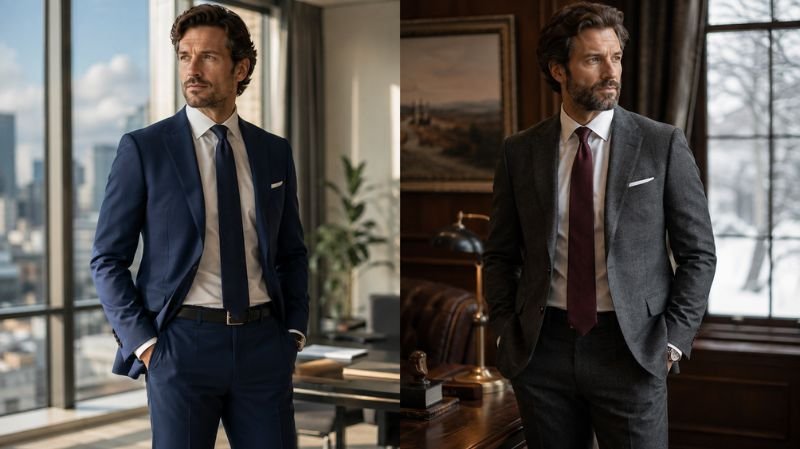
A charcoal flannel suit with a white shirt and dark burgundy tie, for example, creates visual depth without becoming flashy.
How Does Business Professional Differ From Business Casual?

The central distinction is the suit-and-tie foundation.
Business professionals generally use a coordinated suit and traditionally includes a tie. Business casual gives you more freedom to combine tailored trousers, chinos, dress shirts, sweaters, polos, blazers, and other less formal pieces.
Indeed’s current guidance describes business casual as allowing more creativity, while business professional remains the more formal workplace category.
| Element | Business Professional | Business Casual |
| Suit | Usually expected | Optional |
| Tie | Traditionally expected | Usually optional |
| Dress shirt | Yes | Usually |
| Chinos | Generally too casual | Common |
| Polo shirt | Usually no | Sometimes |
| Blazer | Often part of suit | Common |
| Oxford shoes | Excellent choice | Appropriate |
| Loafers | Sometimes | Common |
| Sneakers | Generally no | Depends on workplace |
| Overall impression | Formal and conservative | Polished and relaxed |
Can You Wear Chinos for Business Professionals?
Usually, no.
Chinos are excellent business-casual trousers, but they generally do not satisfy a strict business professional dress code because they lack the formality and matching construction of suit trousers.
If the workplace says “business professional,” choose suit trousers unless the employer explicitly provides a broader interpretation.
Can You Wear a Polo Shirt?
A polo can be appropriate for certain business-casual workplaces, but it should not be treated as a standard business professional shirt.
For business professional dressing, use a proper dress shirt.
Can You Wear Sneakers With a Business Suit?
For strict business professional dressing, avoid them.
Even minimalist leather sneakers can change the visual message of an outfit. They may work beautifully in contemporary business-casual environments, but the fact that something can look stylish does not mean it satisfies every dress code.
What Are the Best Men’s Business Professional Outfit Combinations?
The easiest way to build outfits is to rely on repeatable formulas rather than reinventing your wardrobe every morning.
What Should You Wear With a Navy Suit?
Classic formula:
- Navy two-piece suit
- White dress shirt
- Burgundy or navy tie
- Black Oxford shoes
- Black leather belt
- Dark socks
- Simple watch
This is one of the most dependable business attire men combinations because every component communicates formality without becoming visually busy.
What Should You Wear With a Charcoal Suit?
Try:
- Charcoal suit
- White shirt
- Burgundy tie
- Black Oxford shoes
- Black leather belt
- White or subtle pocket square
This combination works particularly well for interviews, client presentations, and traditional corporate environments.
Can You Wear a Light Blue Shirt With a Navy Suit?
Yes, a light blue shirt makes the navy feel slightly less severe while remaining professional.
Add a burgundy, navy, or dark green tie and dark brown or black leather shoes.
Can You Wear Brown Shoes With a Navy Suit?
Yes, provided the workplace permits them.
Dark brown shoes create a slightly warmer and more contemporary appearance. In an especially conservative setting, black shoes remain the safer choice.
What Are 10 Practical Business Professional Outfit Ideas?
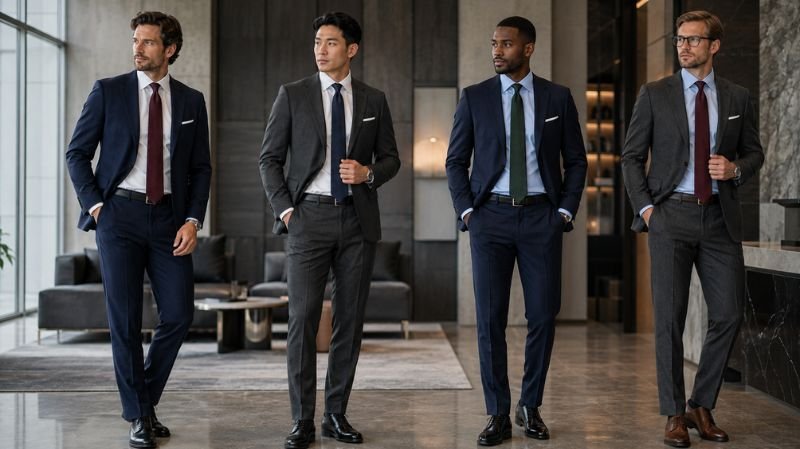
1. Navy Suit, White Shirt, Burgundy Tie
This is the dependable all-rounder.
Use black Oxfords for maximum formality or dark brown leather shoes when the environment permits a warmer interpretation.
2. Charcoal Suit, White Shirt, Navy Tie
Clean, restrained, and highly appropriate for interviews and formal meetings.
The dark-on-light color contrast keeps the outfit sharp without requiring a pattern.
3. Navy Suit, Light Blue Shirt, Navy Tie
This monochromatic approach creates depth through slightly different shades of blue.
It is especially effective when the suit has a subtle texture rather than a high-shine finish.
4. Charcoal Suit, Light Blue Shirt, Burgundy Tie
The burgundy adds controlled color while the charcoal foundation keeps the outfit conservative.
5. Navy Suit, White Shirt, Striped Tie
Choose narrow, traditional stripes rather than oversized or brightly colored patterns.
6. Gray Suit, White Shirt, Dark Green Tie
A restrained dark green tie provides personality while staying within a professional palette.
7. Navy Suit, White Shirt, Black Accessories
Black shoes, black belt, black watch strap, and a dark tie create a particularly formal presentation.
8. Charcoal Suit, White Shirt, Textured Burgundy Tie
Texture can create visual interest without relying on loud patterns.
9. Navy Suit, Pale Blue Shirt, Dark Brown Shoes
A useful modern interpretation for a professional environment that is formal but not exceptionally conservative.
10. Subtle Three-Piece Suit, White Shirt, Conservative Tie
A waistcoat can add formality and visual structure. Use it selectively because a three-piece suit can be more formal than necessary for an ordinary workday.
How Can Men Make Business Professional Attire Look Modern?

Modern professional dressing is about proportion and restraint, not abandoning the dress code.
Should a Business Suit Be Slim or Relaxed?
Aim for a contemporary tailored fit rather than an extreme silhouette.
Avoid:
- Skin-tight trousers
- Excessively narrow lapels
- Jackets that pull across the chest
- Extremely short jackets
- Oversized shoulders
- Excessive trouser stacking
A clean, moderately tailored silhouette tends to age better than a suit built around a temporary trend.
How Can You Add Personality Without Breaking the Dress Code?
Use small details.
For example:
- A textured tie
- A subtle pocket square
- A quality watch
- A tasteful tie bar
- Interesting but conservative socks
- A lightly textured suit
- A distinctive but understated leather briefcase
The strongest professional wardrobes often look simple from a distance and become more interesting up close.
What Does Fashion History Teach Us About Professional Style?
One of the most useful lessons from menswear history is that formality evolves through proportion rather than disappearing overnight.
Museum collections show the transition from more elaborate 18th- and 19th-century men’s dress toward the simpler suit structures that became central to modern business clothing. The Smithsonian specifically identifies the sack or lounge suit as a major business-suit form that dominated much of the 20th century and continued into the 21st.
The Metropolitan Museum also records the movement of the morning suit into daytime business use in the late 19th century.
This history matters because it prevents a common mistake: assuming today’s business suit is some timeless uniform that has never changed.
It has changed repeatedly.
What has remained consistent is the underlying principle of intentionality, clothes that fit, coordinate, and signal respect for the occasion.
What Do Fashion Experts Look for in a Professional Outfit?
From a fashion-editorial perspective, the strongest professional outfit can usually be evaluated through five questions:
1. Does the Fit Look Intentional?
No pulling, excessive fabric, or distracting alterations.
2. Is the Formality Appropriate?
A perfectly styled outfit is still wrong if the occasion calls for a different level of formality.
3. Is the Color Palette Controlled?
Two or three dominant colors are often enough.
4. Is There One Clear Focal Point?
A tie, pocket square, watch, or textured fabric can provide interest. Several competing statement pieces create visual noise.
5. Does the Outfit Look Comfortable?
Comfort influences posture. If a jacket restricts your shoulders or trousers are too tight, the problem becomes visible in how you move.
This is why experienced stylists often prioritize fit, proportion, fabric, and context before brand names.
What Should Men Wear to a Business Professional Interview?
When an interview dress code is unclear, conservative is usually the smarter choice.
A reliable interview formula is:
Navy or charcoal suit + white shirt + conservative tie + polished black or dark brown leather shoes + matching belt.
Avoid experimenting with a new trend on interview day.
You want the interviewer to remember your communication skills, preparation, and qualifications—not an unusually bright tie or distracting suit pattern.
What If the Company Has a More Relaxed Culture?
Research the company first.
If employees routinely wear business casual clothing, a full business professional outfit may be more formal than necessary for an ordinary workday. For an interview, however, slightly more formality can still be appropriate unless the employer specifically advises otherwise.
The safest strategy is to follow explicit instructions over generic internet rules.
What Should Men Wear to Client Meetings and Presentations?

Client-facing situations justify a more conservative approach than an ordinary internal office day.
A navy or charcoal suit with a white or light-blue shirt is an excellent starting point.
For a major presentation, add a conservative tie and polished shoes.
The goal is not to look intimidating. It is to remove unnecessary visual distractions so your expertise and communication remain the focus.
How Can Men Build a Business Professional Capsule Wardrobe?
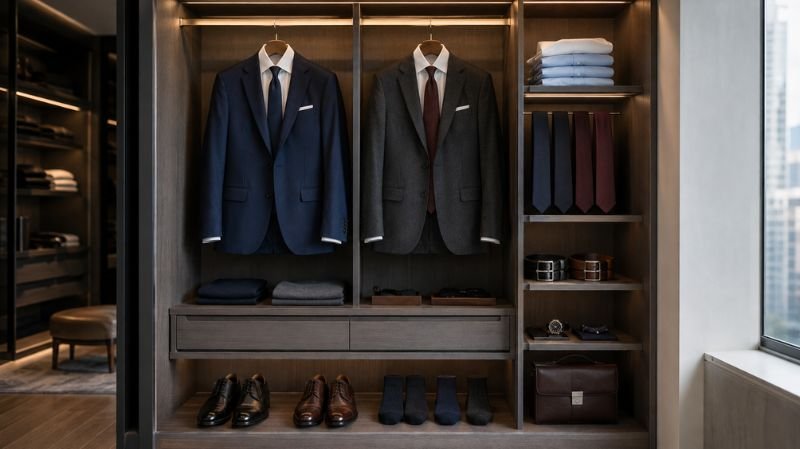
You do not need ten suits.
A practical starter wardrobe could include:
Suits
- 1 navy suit
- 1 charcoal suit
- Optional third suit in medium gray or a subtle pattern
Shirts
- 2 white dress shirts
- 2 light-blue dress shirts
- 1 subtle stripe or conservative pattern
Ties
- Navy
- Burgundy
- Conservative stripe
- Dark green or muted blue
Shoes
- Black Oxford
- Dark brown Oxford or Derby
Accessories
- Black leather belt
- Brown leather belt
- Simple dress watch
- Dark dress socks
- Conservative pocket square
- Professional work bag or briefcase
This combination creates dozens of possible combinations without turning your closet into a showroom.
How Should Men Maintain Professional Clothing?
Professional style is partly wardrobe maintenance.
Before Wearing
Check:
- Collar
- Cuffs
- Buttons
- Trouser creases
- Jacket shoulders
- Shoes
- Belt
- Visible stains
Between Wears
Give suits time to air out instead of automatically sending them to the dry cleaner after every wear. Follow the garment’s care instructions and avoid excessive cleaning that can shorten fabric life.
Use proper suit hangers, allow garments enough closet space, and brush away surface lint.
Rotate suits when possible.
A wardrobe containing fewer high-quality garments that are maintained carefully will generally look better than a large wardrobe full of neglected pieces.
What Are the Most Common Business Professional Dressing Mistakes?
Wearing the Wrong Fit
A $1,000 suit with poor proportions can look less professional than a moderately priced suit that has been properly tailored.
Treating Business Casual as Business Professional
Chinos, polos, casual sneakers, and unstructured overshirts may be stylish, but they do not automatically meet a strict professional dress code.
Choosing Too Many Statement Pieces
Bright tie + patterned shirt + bold pocket square + unusual shoes is usually one element too many.
Ignoring Shoes
Dirty or badly worn shoes are immediately visible.
Wearing an Overly Trend-Driven Suit
Fashion trends have their place. A professional wardrobe should generally prioritize longevity.
Forgetting the Small Details
Wrinkled shirts, incorrect tie length, exposed socks, mismatched belts, and neglected shoes can undermine the whole outfit.
What Does the Modern Business Professional Rule Really Come Down To?
The most useful rule is:
Match the level of formality to the environment, then make the outfit as refined as possible within that boundary.
That principle works better than memorizing an endless list of clothing rules.
A traditional law office may expect a dark suit and conservative tie. A modern financial firm may allow more flexibility. A creative agency may use business casual as its everyday standard.
There is no contradiction.
The dress code belongs to the environment.
Your style belongs to you.
What Is the Difference Between Looking Expensive and Looking Professional?
These are not the same thing.
An expensive suit can look poor if it is badly fitted, wrinkled, or paired with inappropriate shoes.
Conversely, a reasonably priced navy suit can look exceptionally polished when it has:
- Strong shoulder fit
- Clean trousers
- A crisp shirt
- Proper tie length
- Polished shoes
- Coordinated leather accessories
- Appropriate grooming
That is one of the most important lessons for anyone learning professional attire for men: precision beats price.
What Does the Data Tell Us About the Modern Professional Workplace?
Business professional clothing matters because millions of workers remain employed in occupations where formal workplace interactions are part of everyday professional life.
The U.S. Bureau of Labor Statistics reported 31.05 million people in management, business, and financial operations occupations in 2025, including 20.88 million in management occupations.
BLS also reports that management, business, and financial operations occupations represented 19.0% of U.S. employment in its 2025 annual data.
At the same time, workplace dress is clearly becoming more varied. Indeed’s 2026 guidance notes that business casual has become popular in many offices even though business professional remains important in more traditional industries.
So the modern lesson is not that everyone should wear a suit every day.
It is that men should understand when the suit is expected, when it is optional, and how to execute it well when it is required.
What Is the Easiest Formula to Remember?
If you remember only one formula, make it this:
Navy or charcoal suit → white/light-blue shirt → conservative tie → polished leather shoes → matching belt → dark socks → restrained accessories.
Then check three things before leaving:
Fit. Formality. Finish.
If all three are right, you are likely on solid ground.
Final Takeaway
The best men’s business professional attire is not the loudest, most expensive, or most fashion-forward. It is clothing that fits properly, respects the dress code, works for the occasion, and gives the wearer enough confidence to concentrate on the meeting rather than his clothes.
Start with a navy or charcoal suit. Add crisp white and light-blue shirts, conservative ties, polished leather shoes, and coordinated accessories. Once that foundation is dependable, introduce texture, subtle patterns, and modern proportions.
The history of menswear shows that professional clothing has always evolved. Today’s business suit does not need to imitate a boardroom from 1985 to look credible. It simply needs to preserve the principles that have made tailored clothing effective for generations: fit, restraint, quality, coordination, and context.
If you are building your wardrobe from scratch, do not buy everything at once. Start with one excellent navy suit, two versatile shirts, two conservative ties, and one pair of high-quality dress shoes. Build outward from there. That small foundation can become a remarkably versatile professional wardrobe.
Ready to upgrade your work wardrobe? Start with fit first, then build around navy, charcoal, white, light blue, and polished leather. Your goal is not simply to dress formally—it is to look deliberately, confidently, and appropriately dressed for every professional room you enter.
Frequently Asked Questions
1. What is business professional attire for men?
Business professional attire for men is a formal workplace dress code centered on a tailored suit, dress shirt, conservative tie, and traditional leather dress shoes. Navy and charcoal are dependable suit colors, while white and light-blue shirts provide versatile foundations. The exact expectations depend on the employer, industry, and occasion.
2. Does business professional attire require a suit?
In the traditional definition, yes. A complete suit is one of the clearest characteristics separating business professionals from business casual. If an employer specifically identifies its dress code as business professional, a matching jacket and trousers are generally safer than wearing chinos, a polo, or a standalone blazer.
3. Do men have to wear a tie for business professional dress?
A tie is traditionally expected with business professional attire, particularly in conservative industries and formal client-facing situations. Some modern workplaces may interpret the dress code more flexibly, but when expectations are unclear, a conservative tie is the safer choice.
4. What color suit is best for business professional attire?
Navy and charcoal are the strongest all-purpose choices. The navy provides versatility, while charcoal has a particularly conservative appearance. Black can also be appropriate, but it is more formal and often less versatile for everyday business wear. Choose the color according to the workplace rather than fashion trends alone.
5. Are black suits appropriate for business professional attire?
Yes, but they are not always the most versatile choice. Black suits can work in formal corporate environments, presentations, ceremonies, and certain professional settings. Navy or charcoal generally provides more flexibility for everyday office combinations and can look less severe.
6. Can men wear brown shoes with a navy business suit?
Yes. Dark brown shoes can pair effectively with navy, especially in workplaces that allow some modern styling flexibility. For highly conservative environments, black shoes remain the safest option. Keep the belt within the same leather color family as the shoes.
7. Can men wear loafers with business professional attire?
A sleek leather loafer may work in some contemporary professional environments, but traditional business professional dressing favors more formal shoes such as Oxfords or refined Derbies. Avoid casual loafers with highly relaxed construction if the dress code is strict.
8. Is business professional the same as business casual?
No. Business professionals are more formal. It generally centers on a coordinated suit and traditionally includes a tie. Business casual allows more flexibility, including chinos, standalone blazers, polos, sweaters, and—in some workplaces—minimal sneakers. Always follow the organization’s specific dress policy.
9. What should men wear to a business professional interview?
A navy or charcoal suit, white dress shirt, conservative tie, polished leather shoes, matching belt, and understated accessories form a dependable interview outfit. When the company culture is unclear, this approach minimizes the risk of being noticeably underdressed.
10. How should a business professional suit fit?
The jacket should sit smoothly across the shoulders and chest without pulling, while the trousers should sit securely at the waist and fall cleanly toward the shoes. Sleeves should generally reveal a small amount of shirt cuff. The suit should follow the body without being excessively tight or oversized.