Introduction: Why This Fashion Show Still Matters
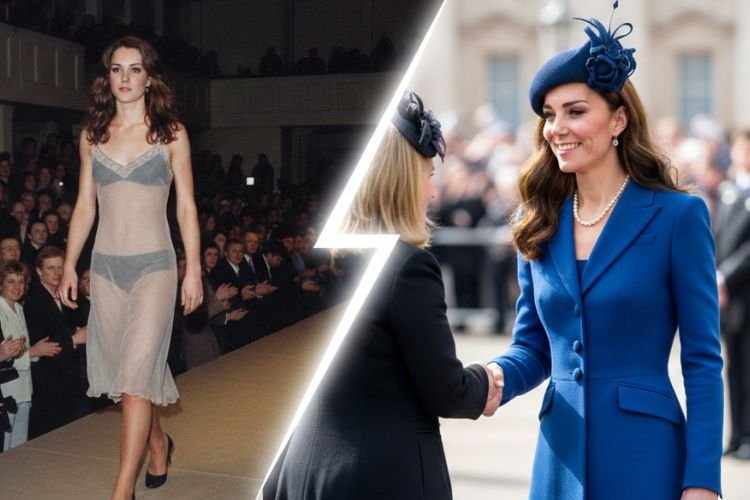
It was a £30 sheer slip dress that launched a thousand headlines—and, over time, became the most replayed “before” image in modern royal history. More than two decades later, people still search for “Kate Middleton fashion show,” not because Catherine, Princess of Wales, ever intended to model, but because this brief, almost accidental student moment has come to symbolize the starting point of one of the most closely scrutinized public transformations of our time.
What began as a student charity fashion show at the University of St Andrews in 2002 has since been replayed, dramatized, and mythologized through tabloids, documentaries, and prestige television. The curiosity hasn’t faded. Instead, it resurfaces whenever her public role evolves or popular culture revisits her past.
This article goes beyond the familiar anecdote. Rather than retelling the same viral story, it explores why this moment endured, how it contrasts with Kate’s later approach to fashion as a senior royal, and what it reveals about media narratives, public fascination, and modern royal image-making. By examining its impact, evolution, and legacy, we can understand why a small university runway still occupies a lasting place in royal fashion history.
What Was the Kate Middleton Fashion Show?
The St Andrews Charity Fashion Show (2002)
The event commonly referenced as the “Kate Middleton fashion show” was a student-organized charity event called Don’t Walk, held in 2002 at the University of St Andrews in Scotland. At the time, Kate Middleton was an art history student—unknown outside her university circle.
Don’t Walk was designed to raise money for charity and featured students modeling outfits in a casual, informal runway setting. It was not a professional fashion show, nor was it intended for media attention. Kate participated simply as one of several student models, not as a featured figure.
Crucially, the event carried no public significance at the time. Its later importance was assigned retrospectively, shaped by Kate’s future role rather than by the show itself.
The retrospective meaning attached to the dress is reinforced by comments from its designer, Charlotte Todd, who later said she did not know who Kate Middleton was at the time. The garment’s cultural significance was not inherent—it was assigned years later, once Kate’s public identity had fundamentally changed.
The Outfit That Made Headlines
Kate wore a sheer, slip-style garment designed by fellow student Charlotte Todd—often described as a dress, though it was originally intended to be worn as a skirt. For the runway, it was styled higher on the body, transforming it into a dress for the show.
In the setting of a student charity fashion event, this kind of improvisation was entirely normal. It reflected the casual creativity and experimentation typical of university showcases, not a calculated fashion statement. The outfit’s later notoriety emerged only in hindsight, once Kate became a global public figure and her wardrobe came to be governed by royal protocol, symbolism, and restraint.
That contrast—between spontaneous student styling and carefully constructed royal image-making—is precisely what made the look irresistible to the media years later.
Why This Moment Became Royal Lore
Prince William’s Presence & Media Narratives
The fashion show entered public memory only after Kate and Prince William’s relationship became known. Journalists revisiting their university years searched for moments that could be framed as meaningful origins, and the runway appearance offered a neat narrative hook.
While Prince William did attend the event, later retellings often blur the line between fact and myth. Headlines simplified the story into a single transformative moment, compressing a long, gradual relationship into a cinematic turning point.
Tabloids amplified the story because it fit a familiar template: the origin story. A future king in the audience, a future princess on the runway, and a visual moment that symbolized “before the palace” proved too compelling to resist.
The Crown Effect: How TV Rewrote the Story
Netflix’s The Crown played a decisive role in reviving and reshaping the fashion show narrative. The episode depicting the event was titled “The Art of Seduction,” a framing that leans heavily into symbolism and irony—particularly when contrasted with Catherine’s later reputation for restraint, diplomacy, and sartorial modesty.
While the series accurately reflects the existence of the charity fashion show, it compresses timelines and amplifies emotional stakes for dramatic effect. This exaggerated “before and after” contrast aligns with the media’s long-standing preference for transformation narratives over historical nuance.
Following the episode’s release, search interest for terms like “Kate Middleton fashion show” spiked noticeably, demonstrating how pop culture can redefine public memory. The event was no longer just historical—it became part of a shared cultural imagination.
From Student Runway to Royal Style Icon
Kate’s Early Fashion Identity (Pre-Royal)
During her university years and early public life, Kate’s style reflected personal experimentation rather than public messaging. Like many young women of the early 2000s, she explored trends freely, without strategic intent.
Fashion during this period was private and expressive. There was no institution to represent and no symbolism to manage—an important contrast to her later role.
The Shift After Joining the Royal Family
Once Kate became engaged to Prince William and entered royal life, fashion took on a new function. Clothing became diplomatic and deliberate, emphasizing structure, restraint, and continuity.
Key elements of this shift included:
- Repeated outfits to signal practicality
- Strong support for British designers
- Symbolic color choices during official engagements
Fashion was no longer about expression—it became communication.
The Birth of the “Kate Effect”
As her visibility increased, so did her influence. Outfits worn during public appearances often sold out within hours, a phenomenon widely referred to as the “Kate Effect.”
This influence extended across both high-street and luxury brands, driven not by trend-setting alone but by consistency and trust. The connection between a student runway moment and global fashion impact illustrates a long narrative arc—one rarely explored in depth.
Why Kensington Palace Now Downplays Fashion Coverage
The Recent Change in Media Strategy
In recent years, Kensington Palace has deliberately reduced its emphasis on outfit details in official communications. The goal is not to dismiss fashion, but to prevent it from overshadowing Kate’s work, leadership, and long-term initiatives.
This strategy is shaped in part by royal history. During Princess Diana’s era, intense focus on clothing often eclipsed charitable causes and policy-driven work—a phenomenon sometimes referred to as the “Diana Effect.” The modern palace approach seeks to avoid repeating that imbalance by positioning fashion as secondary to purpose.
As a senior working royal, Kate’s public image is now framed around substance rather than style—an intentional recalibration designed to keep attention on impact, not appearance.
The Irony: Fashion Still Dominates Headlines
Despite this shift, fashion coverage continues to dominate headlines. Media outlets still dissect her outfits in detail, driven by long-standing public fascination formed years earlier.
This tension—between institutional priorities and audience interest—can be traced back to early moments of fashion visibility, including the St Andrews fashion show. Once fashion becomes a primary narrative lens, it remains difficult to fully separate it from public perception, even when strategy evolves.
Was the Fashion Show a Turning Point — or Just a Symbol?
The fashion show did not create Kate Middleton’s future. It did not determine her relationship or her role. What it became instead was a symbolic origin story—a visual marker used to frame transformation.
Media fascination with “before they were royal” moments reflects a broader storytelling instinct: humanizing power through ordinariness. The fashion show fits this pattern perfectly.
Its significance lies not in causation, but in meaning-making.
Why People Still Search “Kate Middleton Fashion Show” Today
Search interest persists because the query satisfies deeper curiosity—about origins, transformation, and identity. Cultural triggers such as television portrayals, anniversaries, and resurfaced imagery periodically reignite attention.
At its core, the story endures because it follows a timeless arc: ordinary beginnings leading to extraordinary responsibility.
Key Takeaways
- The fashion show was not the start of a modeling career, but a symbolic moment.
- A small student event evolved into global fashion folklore through media repetition.
- Its meaning has changed over time, reflecting Kate’s evolving role and public expectations.
- The story matters less for what happened—and more for what it came to represent.
Frequently Asked Questions
Did Kate Middleton model professionally?
No. She has never worked as a professional model. The fashion show was a one-time student charity event.
Where was Kate Middleton’s fashion show held?
At the University of St Andrews in Scotland in 2002.
Is the fashion show scene in The Crown accurate?
Partially. The event occurred, but its emotional and relational significance was dramatized for television.
Why doesn’t Kate promote fashion as much now?
Kensington Palace prioritizes her leadership and advocacy work over fashion coverage, reflecting her senior royal role.