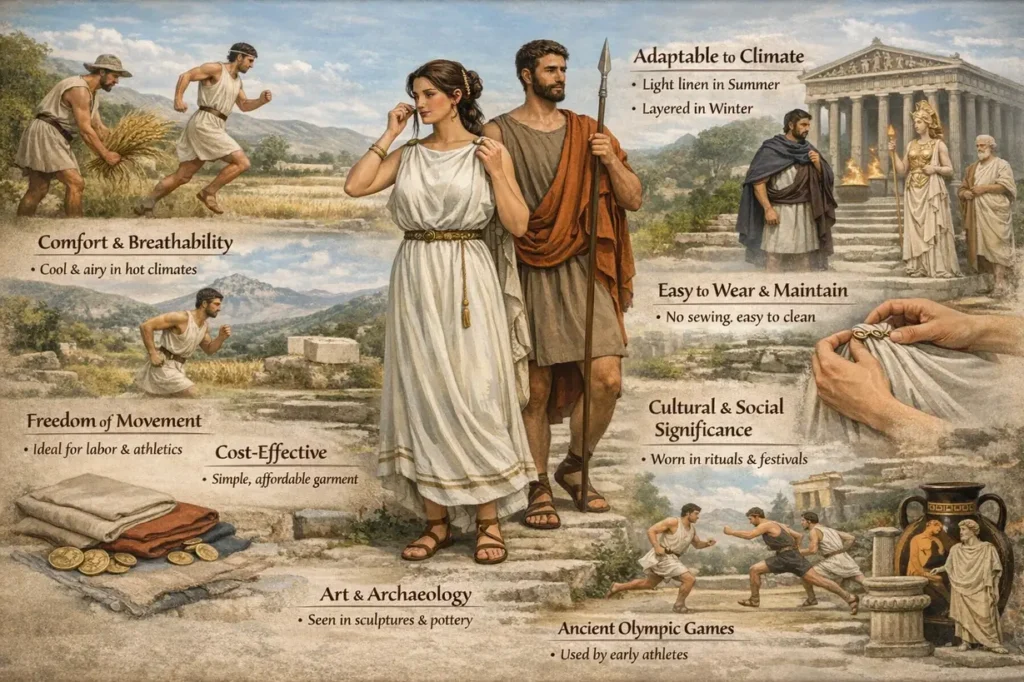
Clothing in the ancient world was far more than a basic necessity—it reflected climate, culture, social structure, and daily lifestyle. Among the many garments worn in antiquity, the chiton stands out as one of the most practical, influential, and widely adopted pieces of clothing in ancient history. Primarily associated with Ancient Greece, the chiton was a simple yet highly functional garment that offered comfort, versatility, and cultural significance.
In this article, we explore what the chiton garment was, its historical background, types, materials, and most importantly, the key benefits of wearing a chiton in the ancient period. Understanding this garment provides valuable insight into how ancient civilizations balanced practicality with aesthetics—lessons that still influence modern fashion today.
Introduction to the Chiton in the Ancient World
The chiton was a tunic-like garment worn by both men and women in Ancient Greece. Typically made from a single rectangular piece of fabric, it was draped around the body and fastened at the shoulders using pins or brooches called fibulae. Unlike complex stitched clothing, the chiton relied on draping and folding, making it easy to wear and adapt.
In ancient societies where daily life involved physical labor, walking long distances, and exposure to varying climates, the chiton offered a perfect balance of simplicity and functionality.
Historical Background of the Chiton
The chiton originated in Ancient Greece around the Archaic period (c. 750–480 BCE) and continued to be worn through the Classical and Hellenistic periods. Over time, its design evolved to reflect changing cultural preferences, regional influences, and social norms.
Initially influenced by earlier Near Eastern garments, the chiton became uniquely Greek in its execution. It symbolized the Greek ideals of harmony, proportion, and practicality, which were central to their philosophy and way of life.
Types of Chiton Worn in Ancient Times
There were two main types of chiton commonly worn in the ancient period:
1. Doric Chiton
- Made primarily from wool
- Simpler and heavier in appearance
- Typically worn by men and Spartan women
- Often sleeveless and shorter in length
2. Ionic Chiton
- Made from lightweight linen
- More flowing and elegant
- Featured multiple pins along the arms
- Commonly worn by women and in formal settings
Men’s vs Women’s Chiton
While men often wore shorter chitons for ease of movement, women’s chitons were generally ankle-length, offering modesty while maintaining elegance.
Materials Used in Chiton Garments
The choice of fabric played a crucial role in the chiton’s effectiveness:
- Linen: Ideal for hot Mediterranean climates due to its breathability
- Wool: Provided warmth during cooler seasons
- Natural dyes: Derived from plants, minerals, and insects
- Undyed fabric: Common among lower social classes for affordability
The use of natural materials ensured comfort, sustainability, and durability—key benefits in an era without industrial textile production.
Key Benefits of Chiton in the Ancient Period
The chiton offered numerous advantages that made it a staple garment for centuries.
1. Comfort and Breathability
Loose-fitting and lightweight, the chiton allowed air circulation, making it ideal for warm climates. Unlike restrictive clothing, it did not hinder natural body movement.
2. Freedom of Movement
The draped design supported physical activities such as:
- Farming
- Walking long distances
- Athletic training
- Household labor
This freedom was essential in a society that valued physical fitness and outdoor life.
3. Adaptability to Climate
The same garment could be adjusted for:
- Summer (lighter fabric, shorter length)
- Winter (layered with a himation or cloak)
This adaptability reduced the need for multiple clothing items.
4. Easy to Wear and Maintain
With minimal stitching involved, the chiton was:
- Easy to put on and remove
- Simple to clean and repair
- Reusable for different occasions
5. Cost-Effective and Accessible
Because it required just one piece of fabric, the chiton was affordable for people across social classes, from laborers to elites.
Social and Cultural Significance of the Chiton
Beyond practicality, the chiton held deep cultural meaning.
- Represented Greek identity
- Indicated social status through fabric quality and color
- Worn during festivals, religious ceremonies, and public gatherings
In art and sculpture, gods, athletes, and philosophers are often depicted wearing chitons, emphasizing their symbolic importance.
Practical Advantages for Ancient Lifestyles
The ancient Greek lifestyle demanded clothing that could adapt to diverse daily needs.
Practical benefits included:
- Suitable for indoor and outdoor activities
- Could be belted differently for work or leisure
- Allowed layering for travel and warfare
- Gender-neutral base design
For soldiers and travelers, the chiton provided mobility without sacrificing coverage.
The Chiton in Ancient Olympic Games
A notable real-life example of chiton usage comes from the ancient Olympic Games. Athletes initially wore short chitons during competitions and training. Over time, they transitioned to competing nude, but the chiton remained essential before and after events, offering comfort and ease of movement.
This demonstrates how the chiton supported active lifestyles, reinforcing its practical value in ancient society.
Chiton Compared to Other Ancient Garments
Chiton vs Himation
- Chiton: Inner garment, lightweight, worn daily
- Himation: Outer cloak, heavier, used for warmth or formality
Chiton vs Roman Tunic
- Chiton relied on draping and pins
- Roman tunic involved more stitching
- The chiton was generally more flexible in styling
The chiton’s simplicity made it more versatile than many contemporary garments.
Influence of the Chiton on Modern Fashion
Elements of the chiton continue to influence modern fashion in subtle yet powerful ways. Its distinctive draping style can be seen in contemporary dresses that emphasize natural flow and movement rather than rigid structure. Tunic-style tops, popular for their comfort and versatility, closely resemble the chiton’s simple silhouette.
Grecian gowns worn at formal events often borrow from the garment’s soft folds and shoulder-fastened designs, reflecting classical elegance. Even minimalist fashion trends echo the chiton’s philosophy of simplicity, clean lines, and functionality. Many modern designers consciously revisit the chiton’s timeless form, adapting its fluid structure to create clothing that feels both elegant and effortlessly wearable.
Archaeological and Literary Evidence
Evidence of the chiton’s use in the ancient period is drawn from multiple reliable historical sources. Ancient Greek literary works, including writings by Homer and Herodotus, frequently mention the chiton as everyday attire, highlighting its social importance. Visual representations found on vase paintings and stone sculptures further illustrate how the garment was worn and styled by men and women.
In addition, textile fragments uncovered at archaeological sites provide physical proof of its materials and construction techniques. Together, these literary, artistic, and archaeological findings confirm that the chiton was widely worn across regions and maintained its relevance throughout various phases of ancient Greek civilization.
Conclusion
The chiton was far more than a simple piece of clothing. Its comfort, affordability, adaptability, and cultural significance made it one of the most effective garments of the ancient period. Designed to suit both everyday labor and ceremonial occasions, the chiton reflected the practical wisdom of ancient civilizations.
Even today, the principles behind the chiton—simplicity, sustainability, and versatility—remain relevant. Studying such garments helps us better understand how ancient societies lived, worked, and expressed identity through clothing. If you’re interested in ancient history, fashion evolution, or cultural studies, exploring garments like the chiton offers valuable insights into human innovation and lifestyle adaptation.