In 2015, a single photograph of a dress sparked one of the biggest internet debates ever seen. Some people were convinced the dress was white and gold, while others insisted it was blue and black. Even today, people still search for answers about the dress illusion, wondering why the same image can look completely different depending on who is viewing it.
The white and gold dress illusion became popular because it highlighted something fascinating about human vision: we do not all see color in exactly the same way. The brain interprets light, shadow, contrast, and surrounding colors differently, which is why two people can look at the same photo and strongly disagree.
For anyone asking “what is the dress colour” or “what color is the dress,” the actual dress is blue and black. However, the reason many people see white and gold is connected to how the brain processes lighting conditions.
What color is the dress?
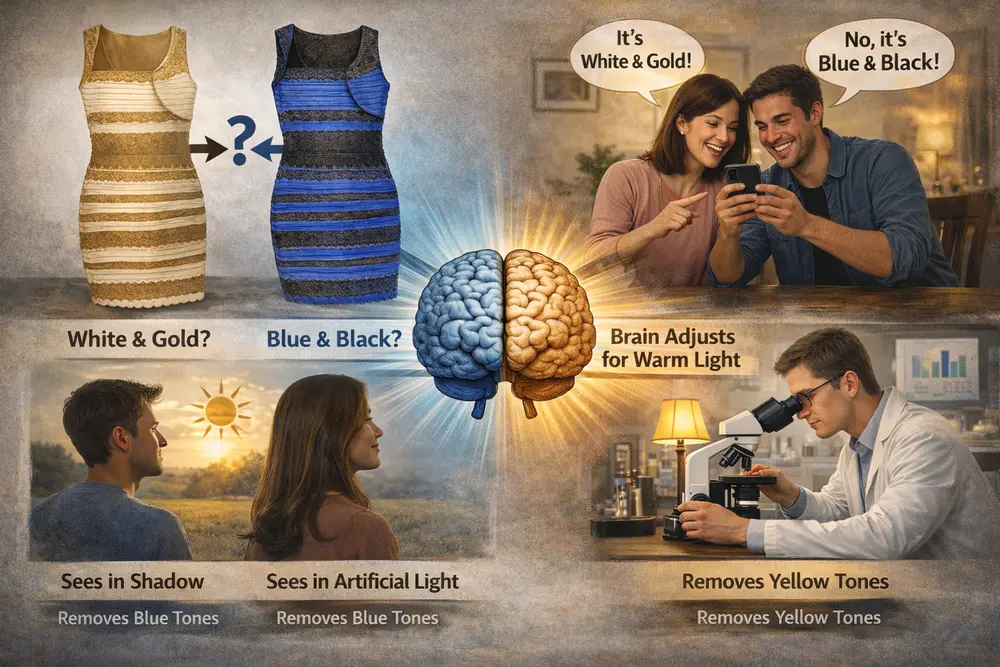
The real dress is blue and black. However, many people see it as white and gold because the brain interprets the lighting in the image differently. People who assume the dress is in shadow often see white and gold, while people who assume it is under artificial light tend to see blue and black.
Quick Comparison Table: White and Gold vs Blue and Black Perception
| What People See | Brain’s Lighting Assumption | Resulting Perception |
| White and Gold | Natural daylight or blue shadow | Brain subtracts blue tones |
| Blue and Black | Artificial or yellow indoor lighting | Brain subtracts yellow tones |
| Mixed Perception | Unclear lighting conditions | Colors may shift over time |
What Is the White and Gold Dress Illusion?
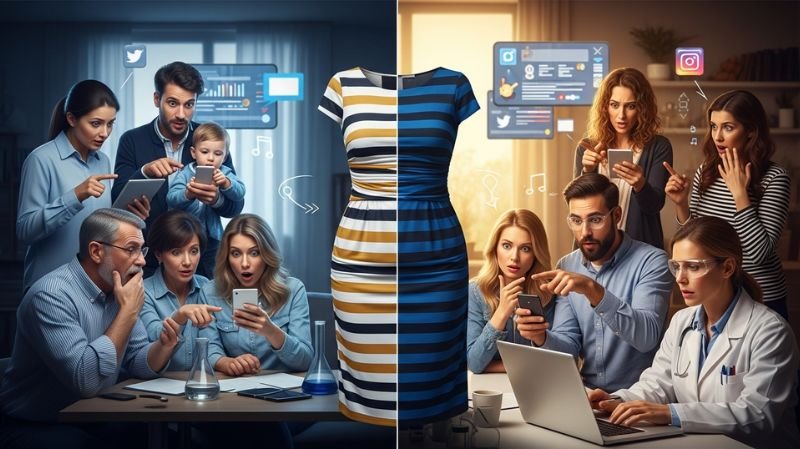
The white and gold dress illusion refers to a photograph of a striped dress that went viral on social media in 2015. The image caused widespread disagreement because some viewers saw the dress as white and gold, while others saw it as blue and black.
The debate spread across platforms like Twitter, Facebook, Tumblr, and Reddit. Celebrities, scientists, and news outlets joined the discussion. Even families and friends argued over what color the dress actually was.
The illusion dress gold and white debate became famous because it exposed the difference between physical reality and human perception. Although the actual dress was blue and black, millions of people genuinely saw white and gold.
When Did the Dress Go Viral?
The viral dress photo first appeared online in February 2015. It quickly became one of the most shared images in internet history.
Within hours:
- Millions of people had viewed the image
- Hashtags like #whiteandgold and #blackandblue started trending
- News websites published articles explaining the science behind the illusion
- Researchers began studying why people saw different colors
Major media organizations including entity[“organization”,”BBC”,”British Broadcasting Corporation”], entity[“organization”,”The New York Times”,”American newspaper”], and entity[“organization”,”National Geographic”,”Science and education organization”] covered the story extensively.
What Color Is the Dress Actually?
The actual dress shown in the photo is blue and black.
It was sold by the British fashion brand entity[“brand”,”Roman Originals”,”British clothing retailer”]. After the image became viral, the company confirmed that the dress was made with blue fabric and black lace.
This answer may seem simple, but it does not fully explain why so many people continue to see white and gold. The confusion comes from how the brain interprets the lighting in the photograph.
Why Do People See Different Colors?
The reason people see different colors comes down to visual perception.
Our eyes collect light, but it is the brain that decides what those colors mean. When we look at a photo with unclear lighting, the brain has to guess whether the image is:
- In bright daylight
- In a dark shadow
- Under yellow indoor light
- Overexposed
- Underexposed
The dress image had poor lighting and unclear background details. Because of this, people’s brains made different assumptions.
People Who See White and Gold
People who see the dress as white and gold usually assume that the photo is taken in a shadow or under bluish daylight.
When the brain thinks an object is in shadow, it automatically removes blue tones from the image. Once that blue tint is removed, the dress appears lighter, making the blue fabric look white and the black lace look gold.
People Who See Blue and Black
People who see blue and black usually assume the dress is under warm indoor lighting.
Artificial lighting often has yellow tones. The brain removes those yellow tones, making the blue and black colors easier to recognize.
This is why two people can look at the exact same image and still disagree.
The Eye System’s Role in the Dress Illusion
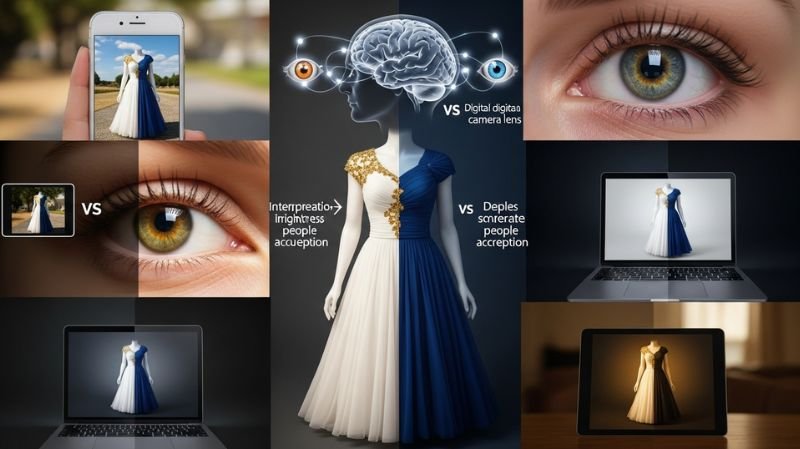
The eye system plays a major role in the dress illusion because our vision is not like a camera. Cameras record colors exactly as they appear, but our eyes and brain work together to interpret what we see.
The color experience of each person can be different because people respond differently to:
- Light exposure
- Contrast
- Shadows
- Brightness
- Screen settings
- Past experiences with similar lighting
Some people are more influenced by the context surrounding an image, while others focus only on the object itself.
This explains why the white and gold dress illusion remains one of the most interesting examples of how vision can vary from person to person.
Authority Insight: What Researchers Found
According to research published in the entity[“organization”,”Journal of Vision”,”Scientific journal”], the neuroscientist entity[“people”,”Pascal Wallisch”,”New York University neuroscientist”] surveyed more than 13,000 people about the dress illusion.
He found that people who saw the dress as white and gold were more likely to assume the dress was photographed in natural light. People who saw blue and black were more likely to assume the dress was under artificial light.
Wallisch explained that shadows are often bluish, so the brain removes that blue light to compensate. As a result, the dress appears white and gold. However, when the brain assumes artificial yellow lighting, it removes yellow tones instead, leaving the dress looking blue and black.
This research became one of the strongest scientific explanations for why the dress illusion divided people so dramatically.
Understanding Color Constancy
One of the most important concepts behind the dress illusion is color constancy.
Color constancy is the brain’s ability to recognize the true color of an object even when the lighting changes.
For example:
- A white shirt still looks white outdoors in sunlight
- The same shirt still looks white indoors at night
- A red apple still looks red in bright daylight or dim kitchen lighting
The brain constantly adjusts for different light sources so objects appear consistent.
In the dress photo, the lighting is unclear, so the brain struggles to determine what adjustments should be made. This is why the illusion is so powerful.
Example of the Dress Illusion
Imagine two friends looking at the same photo on different devices.
One friend views the image on a bright smartphone outdoors in sunlight. The other views it on a dim laptop screen inside a dark room.
The outdoor viewer may see the dress as white and gold because the sunlight affects how the brain interprets shadows. Meanwhile, the indoor viewer may see the dress as blue and black because the screen contrast makes darker colors stand out.
This real-life example shows why screen brightness, device quality, and environment can influence perception.
Types of Optical Illusions
The dress illusion belongs to a larger category known as optical illusions. These illusions occur when the brain interprets visual information differently from reality.
There are three major types of optical illusions.
1. Literal Optical Illusions
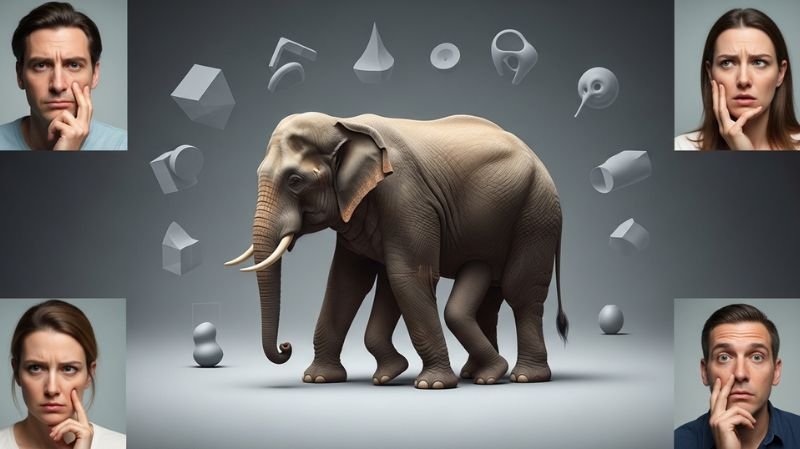
Literal optical illusions happen when the image we see is different from the actual object.
For example, an image may appear to contain more shapes, lines, or body parts than it really does.
A famous example is the elephant illusion, where an elephant appears to have too many legs because the brain struggles to match the legs correctly.
Literal optical illusions often depend on:
- Overlapping shapes
- Hidden lines
- Confusing edges
- Incomplete visual information
2. Physiological Optical Illusions
Physiological optical illusions happen when the eyes are overstimulated by brightness, color, movement, or contrast.
For example, if you stare at a bright object for too long, you may see afterimages when you look away.
These illusions can also happen when:
- A flat image appears three-dimensional
- Moving patterns seem to shift
- Bright colors create visual distortion
The brain becomes overwhelmed by strong visual signals and interprets the image incorrectly.
3. Cognitive Optical Illusions
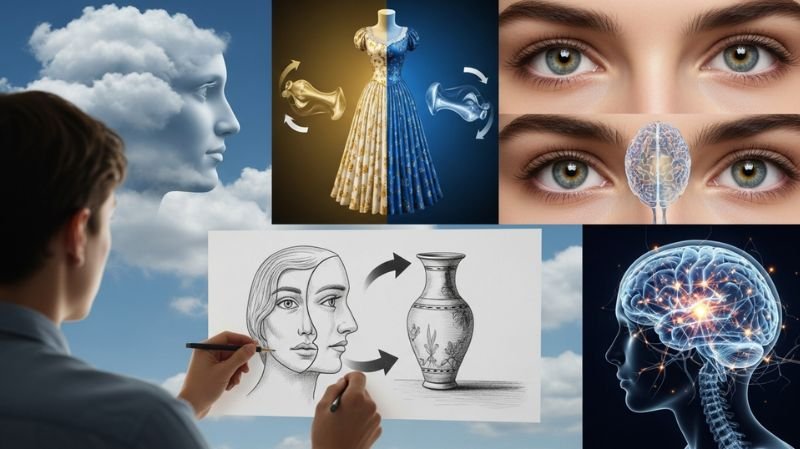
Cognitive optical illusions depend entirely on how the brain interprets information.
These illusions happen because the brain uses past experiences and assumptions to understand what it sees.
The dress illusion is a perfect example of a cognitive illusion because the brain is making a guess about the lighting conditions.
Other common cognitive illusions include:
- Faces hidden in clouds
- Images that can look like two different objects
- Drawings that seem to flip between two viewpoints
Why the Dress Illusion Became So Popular
The dress illusion became popular because it created a strong emotional reaction.
People could not believe that someone else could see completely different colors in the same image.
The debate was also highly shareable because:
- Everyone could participate instantly
- The image was simple and easy to understand
- There seemed to be only two possible answers
- People felt strongly that they were correct
The illusion became one of the earliest examples of a truly global viral internet moment.
Can Age, Gender, or Sleep Affect What You See?
Research suggests that several personal factors may influence how people interpret the dress photo.
These include:
- Age
- Sleep habits
- Time spent outdoors
- Exposure to natural light
- Device brightness
- Color sensitivity
Some studies found that people who wake up early and spend more time in natural daylight were more likely to see white and gold.
People who stay up late and spend more time under artificial lighting were more likely to see blue and black.
Although these patterns are not always exact, they help explain why people can interpret colors differently.
Other Famous Optical Illusions Similar to the Dress
The dress illusion is not the only example of the brain misinterpreting information.
The Sneaker Illusion
A photo of a sneaker became viral because some people saw it as gray and teal, while others saw pink and white.
Like the dress, the sneaker illusion depended on how people interpreted lighting and contrast.
The Yanny vs Laurel Debate
This illusion involved sound instead of color.
Some people heard the word “Yanny,” while others heard “Laurel.” The difference came from how the brain processed different sound frequencies.
The Spinning Dancer Illusion
This illusion showed a dancer who appeared to spin clockwise for some people and counterclockwise for others.
The image highlighted how the brain can switch between multiple interpretations.
What the Dress Illusion Teaches Us
The dress illusion teaches us that perception is not always reality.
Even though the dress is objectively blue and black, millions of people genuinely saw it as white and gold.
This does not mean one group was wrong. Instead, it shows that the brain relies on assumptions to interpret incomplete information.
The illusion reminds us that:
- People can experience the same image differently
- Vision depends on lighting and context
- The brain often fills in missing details automatically
- Perception is influenced by personal experience
Conclusion
The white and gold dress illusion remains one of the most fascinating examples of how the human brain works. Even though the actual dress is blue and black, millions of people continue to see white and gold because the brain interprets lighting differently.
The dress illusion shows that color is not just about what reaches our eyes. It is also about how the brain processes shadows, brightness, and surrounding context. This is why questions like “what color is the dress” and “what is the dress colour” still continue years after the original photo went viral.
Understanding the science behind the white and gold dress illusion helps us appreciate how complex human vision really is. It also reminds us that two people can look at the same image and honestly experience it in completely different ways.
At Styling Mania, we love exploring viral fashion moments that blend style, psychology, and visual perception. The white and gold dress illusion is more than just an internet debate — it is a reminder that fashion can spark global conversations about how people see the world differently.
If you enjoyed learning about the illusion dress gold and white debate, explore more optical illusion content and share this article with friends to see what colors they see in the dress.
FAQs
1. What color is the dress really?
The actual dress is blue and black, even though many people see it as white and gold.
2. Why do some people see white and gold?
People who see white and gold usually assume the image is in bluish shadow, causing the brain to remove blue tones.
3. Why do some people see blue and black?
People who see blue and black often assume the image is under warm artificial lighting.
4. Is the dress illusion an optical illusion?
Yes, the dress photo is considered a cognitive optical illusion because it depends on how the brain interprets light.
5. Can screen brightness change the colors?
Yes, screen brightness, contrast, and display quality can influence how the dress appears.
6. Why did the dress go viral?
The dress became viral because people strongly disagreed about its colors and wanted to prove they were right.
7. Is everyone seeing the same image?
Yes, everyone is seeing the same photo, but the brain interprets the lighting differently.
8. Can your eyes switch between white and gold and blue and black?
Yes, some people report seeing different colors at different times depending on the screen or lighting.
9. What type of illusion is the dress?
The dress is mainly a cognitive optical illusion because it depends on assumptions and mental interpretation.
10. Why is the dress illusion still popular today?
The illusion remains popular because it is one of the best examples of how differently people can perceive the same thing.